Showing posts with label wwi. Show all posts

Sunday, April 24, 2016

The Summer Before the War by Helen Simonson

★★★ 1/2
"Her favorite summer memories were not of events themselves, of picnics, sea bathing, tennis afternoons and cricket matches, but of watching Hugh and Daniel enjoying them and locking into memory the delight in their faces and their open hearts."

This historical novel is set in Rye, a small town in East Sussex of England, in the year 1914.  It is, essentially, the "summer before the war" and everything is going as usual: Hugh Grange has returned for the summer from his medical studies to live with his Aunt Agatha and Uncle John.  His cousin Daniel is trying to publish his poetry.  The town is in the process of hiring a new Latin master.  And in the mist of everything, the country may be going to war.

And then Beatrice Nash arrives with her bicycle and crate of books and her free-thinking spirit soon takes the town by surprise.

I loved the author's first book, 'Major Pettigrew's Last Stand' and was looking forward to this one as well.  Unfortunately, this one just didn't work they way I expected it to.  The beginning had the same wonderful small-town charm of 'Major Pettigrew' and I loved the character of Beatrice, but then the novel started to go off in all different directions.  There were too many new characters introduced and I felt that the focus drew further and further away from Beatrice and Hugh.  The book dragged on and on and then the ending felt far too rushed and I found myself not caring as much about the characters as I should have.  

That being said, I still enjoyed a lot of aspects of the book.  I really liked the description of Rye and the feeling of pre-war England.  The Belgian refugees also added a very unique aspect to the books and created a lot of comparisons to later periods of history.

Wednesday, August 12, 2015

The Buddha in the Attic by Julie Otsuka (audio)

★★★ 1/2
"Women are weak, but mother's are strong."

This was the first audio book that I have listened to since I stopped having to drive an hour to work and back everyday to Whitewater.  Since I'm going to start doing a lot more driving soon on a daily basis, I figured I might as well get some more books read.

This book was descent.  The author uses different themes to describe a group of mail-order Japanese bride's experiences as they travel from Japan and live their new lives in the United States.   The story was told by strings bits and pieces of each women's live together as they adapted to new challenges in a world completely different in the one that they had grown up in.  It talked about everything from the voyage to America to wife and motherhood to the war.

I'm glad I listened to it as an audiobook - the author had a unique way to blending each women's lives together that was brought out by the narrator.  I really enjoyed this technique for the first couple of chapters, but it started to seem a bit like an essay after awhile - one of the main reasons why I did not give it more stars.  Plus, I found myself way to invested in each of the characters.  After finishing the book, I really wanting to what happened to each of the women because I couldn't at all tell who was who.

Wednesday, July 30, 2014

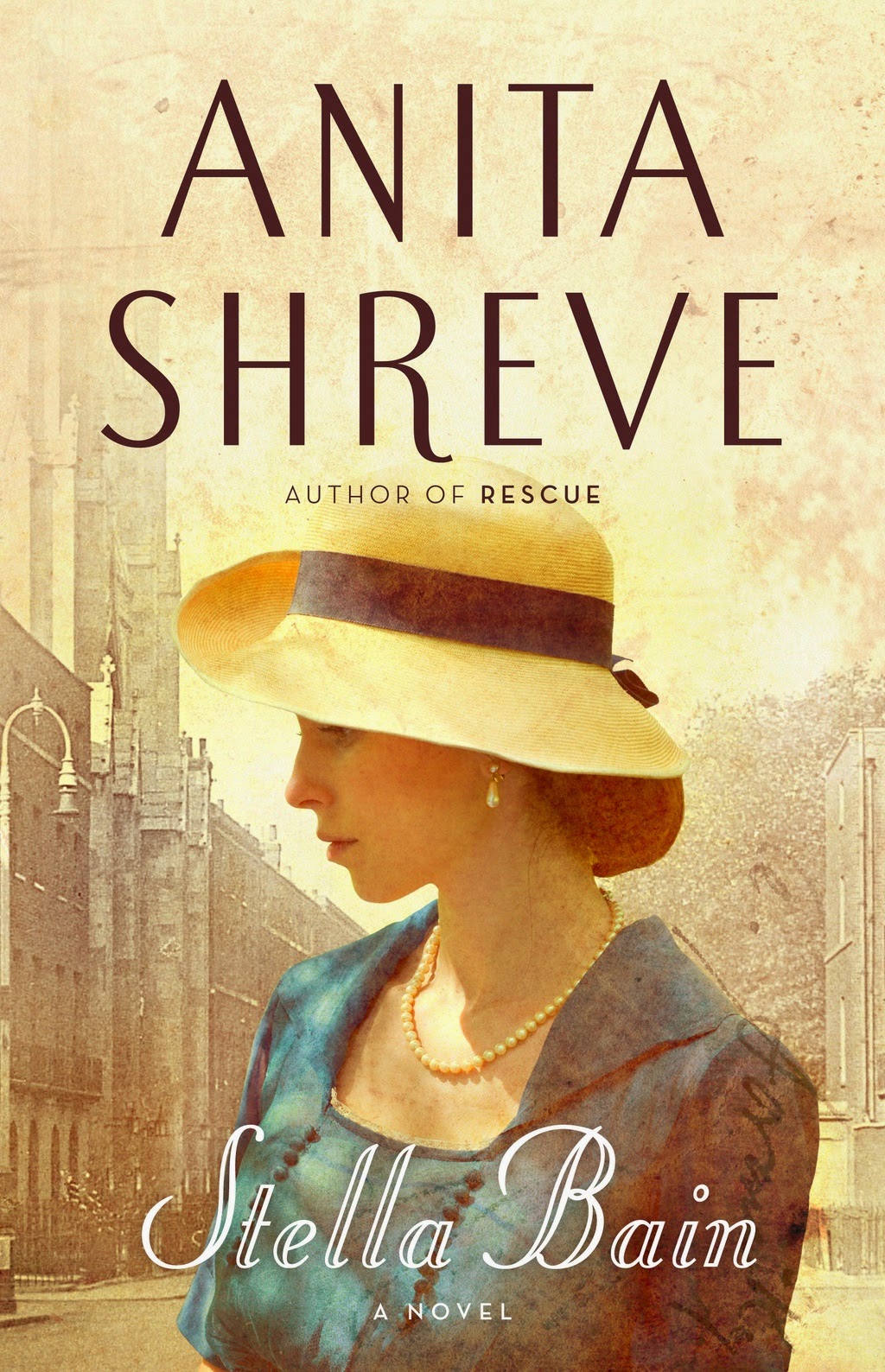
Stella Bain by Anite Shreve (audio)

"He will be her one-room cottage, her oasis."

I didn't really like this book - at all.  The only other book I've read by Anita Shreve is Resistance - which I enjoyed, but this one was hard to get through.  Thank goodness it was short and an audio book, otherwise I don't know if I would have finished it.

 The story seemed interesting: American women suffers shell shock in World War I while volunteering as a nurse and end up in London.  Her memory gone, she struggles to find out who she really is.  After many months she realizes that she has two children in America and returns to fight for custody from her husband.  It seemed a little far-fetched and it drove me crazy that she ran off to the war without telling her children or even writing to them.  Eh. Plus she ends up "falling in love" with the man who takes care of her in London after his wife dies in child- birth. Eh again.
 

Thursday, July 3, 2014

All Our Worldly Goods by Irene Nemirovsky

★ 1/2
"Everyone waited for the war to start the way people wait for death: knowing it is inevitable, asking only for a little more time."

I read Nemirovsky's novel Suite Francaise a few years ago and loved it!  This novel is also set in France and covers the period from right before World War I in 1911 through the beginning of World War II.  It end quite optimistic in 1940 - a bit ironic considering Nemirovsky was killed in Auschwitz before she could finish Suite Francaise.  

The story follows Pierre and Agnes, who are disowned by Pierre's grandfather when he decides to marry for love and not marry Simone who he was promised to.  Brought up in a rich family, Pierre and his family are forced to make their own lives in the world.  He survives the first war only to send his son off to the second war years later.  Simone also appears through out the story, and Pierre's decisions have great consequences for him and his family.  

I'm not sure why this took me so long to get through.  It was beautifully written and brings to live small-town France during a unique time period between the world wars.  There is a lot of character development and themes of family, abandonment, war, and community.  It also is a great prequel to Suite Francaise - even though the characters and story are completely different.

Monday, June 23, 2014

Eight Girls Taking Pictures by Whitney Otto (audio)

"Later, Jenny would say she seldom knew what she would take a picture of when she picked up a camera, that she only knew once she peered through the viewfinder, as if the photograph had finally found her."

This book was not at all what I was expected.  I guess I thought it would be a novel - but it was actually eight short stories about eight different girls who were photographers in the late 1900's to 1980's.  The research was excellent (from what I could tell) and the writing rather good in some parts, but I guess this book just wasn't for me.

My main issue with the book was that all of the eight characters seemed exactly the same.  One of the stories might have been a great stand alone short-story, but after reading a few, I couldn't really tell one apart from another.  They all seemed like the same person, but in a different time period and slightly (and I mean slightly...) different circumstances.  Many this was the author intention?  Either way, it got annoying after awhile.  It also was way to feminist for me.  All of the girls had major conflict between their photography careers and their family/love interest.  Being set in the time period that it was, I understand there was a real battle here (you couldn't usually be a famous photographer and a wife/mother at the same time), but I felt like each character made the same choice.  It was annoying.  The books only saving grace was the reference to different characters through out the stories - espeically at the end reference to Cymbeline (the first women's story).  I felt like this book could have been great, but it just wasn't.

Monday, June 9, 2014

Letters from Skye by Jessica Brockmole (audio)

"You glided over to me and, as I was struggling to think of something intelligent to say, you said 'There you are.'  I often think of that, Sue.  Here I am.  No matter where I am in the world, 'Here I am.' "

Goodreads Summary: A sweeping story told in letters, spanning two continents and two world wars, Jessica Brockmole’s atmospheric debut novel captures the indelible ways that people fall in love, and celebrates the power of the written word to stir the heart.

March 1912: Twenty-four-year-old Elspeth Dunn, a published poet, has never seen the world beyond her home on Scotland’s remote Isle of Skye. So she is astonished when her first fan letter arrives, from a college student, David Graham, in far-away America. As the two strike up a correspondence—sharing their favorite books, wildest hopes, and deepest secrets—their exchanges blossom into friendship, and eventually into love. But as World War I engulfs Europe and David volunteers as an ambulance driver on the Western front, Elspeth can only wait for him on Skye, hoping he’ll survive.
June 1940: At the start of World War II, Elspeth’s daughter, Margaret, has fallen for a pilot in the Royal Air Force. Her mother warns her against seeking love in wartime, an admonition Margaret doesn’t understand. Then, after a bomb rocks Elspeth’s house, and letters that were hidden in a wall come raining down, Elspeth disappears. Only a single letter remains as a clue to Elspeth’s whereabouts. As Margaret sets out to discover where her mother has gone, she must also face the truth of what happened to her family long ago.

- - - - - - - - - - - 

This novel is told completely in letters: in 1912 between Elspeth and David and years later in 1940 between Margaret and Paul and Margaret and her mother.  The style reminded me a bit of The Guernsey Literary and Potato Peel Pie Society by Mary Ann Shaffer and Annie Barrow - another novel told through letters.  I loved the idea of letter writing - something that is rare in today's modern world of texts and emails.  With all of the instant communication, it's hard to imagine a time when it messages would take weeks to reach someone!  There is something wonderfully romantic about getting to know someone and falling in love through letters.

Brockmole tells the epic love story of Elspeth and David, who develop an unexpected correspondence when David writes Elspeth a fan letter after reading her book of poetry.  They quickly realize they have a lot in common and their friendship slowly develops into something more.  The two fall in love in unexpected circumstances - Elspeth is already married and David has recently enlisted as an ambulance driver in France. Over the years, the two struggle with finding a way to make their relationship work.  Call me old-fashioned, but it sort-of bothered me that Elspeth was developing a relationship with David when she was married to someone else (similar to how I felt about the characters in Loving Frank by Nancy Horan).  I understood where they were coming from, but I still didn't exactly like it.  That being said, the situation did bring about a lot of complex emotions and decisions that might not have otherwise been there.  

Overall, I enjoyed this book.  I was a little cliche at times, but I liked the story really liked the author's description of the time period and setting (particularly the island of Skye).  It was also really interesting to read Elspeth and David's letters while learning about Margaret's journey to find out about her mother's past.

Friday, June 6, 2014

Life After Life by Kate Atkinson

"What if we had a chance to do it again and again, until we finally did get it right?  Wouldn't that be wonderful?"

Goodreads Summary: On a cold and snowy night in 1910, Ursula Todd is born, the third child of a wealthy English banker and his wife. Sadly, she dies before she can draw her first breath. On that same cold and snowy night, Ursula Todd is born, lets out a lusty wail, and embarks upon a life that will be, to say the least, unusual. For as she grows, she also dies, repeatedly, in any number of ways. Clearly history (and Kate Atkinson) have plans for her: In Ursula rests nothing less than the fate of civilization.

- - - - - - - - - - - - 

This was somewhat of a difficult novel for me.  It was a bit confusing and I wasn't sure I "got" everything. Even though I struggled to get through it at times, there were many things that I loved about this book.  I read a lot of books, and I sometimes find myself reading the "same story" over and over again.  Kate Atkinson managed to take a simple concept (being born over and over again into the same life) and create a unique and complex story.

Each time Ursula is reborn, her life takes a slightly different path.  She managed to avoid one disaster after another, but then ends up with a different problem. I kept hoping that Ursula would finally "get it right," but that wasn't really the goal of the story. This novel is more about life more than anything and how it is effected by the everyday choices that we make.  I also loved the the novel was set in England during both World War I and II.  Usually books tend to focus on one war or the other.  I also really loved all of the different characters that Atkinson created to weave in and out of Ursula's life.

This book was #8 on my top ten list of 2014.

Friday, September 27, 2013

The Sandcastle Girls by Chris Bohjalian (audio)


"But history does matter.  There is a line connecting the Armenians and the Jews and the Cambodians and the Bosnians and the Rwandans.  There are obviously more, but, really, how much genocide can one sentence handle?"

The Sandcastle Girls is the first novel I have read by Chris Bohjalian and I loved it!   Deeply moving and unforgettable, the book centers around the Armenian Genocide of 1915 and tells the story of Elizabeth, a young girls from America and an Armenian soldier named Armen.  After refusing to marry, young Elizabeth arrives in Aleppo, Syria with her father to aid Armenian refugees during World War I.  Elizabeth is horrified by the conditions that the refugees are in and is overwhelmed by their situation and tragic pasts.  She makes many connections with the Armenian people, including Armen, a young engineer.  Just as they begin to realize their feelings for one another, Armen travels to Eqypt to enlist in the British army.   Throughout the next year, they write each other letters and begin to fall in love.  Years later, Elizabeth's grand-daughter, Laura, researchers the story of her grandparents and learns of the tragedies and secrets that they both overcame.

I really liked that the novel centers on two narrators in different time periods - Elizabeth in 1915 and Laura in the present.  As Laura was learning more and more about her grandparent's history, Elizabeth was living through it in the past.  Like the author mentioned in an interview, Laura's narrative also gave the readers a much needed escape from the horrors of the Armenian Genocide.

This is the first time that I have really read anything about the Armenian Genocide.  The narrator of Laura often refers to this time of the "tragedy that you know next to nothing about" and it couldn't be more true.  I've spend a lot of time reading and learning about the holocaust and I was really surprised at how similar these events were - and how little I knew about the circumstances of the Armenians.  Over 1.5 million people were killed during this time and I'm not sure why so little is known about it.  History is interesting that way - and Bohjalian did an amazing job of writing a tribute to the Armenian people that was sad and beautiful and filled with hope.

This book was #3 on my top ten list of 2013.


Friday, February 8, 2013

The Shoemaker's Wife by Adriana Trigiani

"He promised to love me.  And for once in my life, I'm going to do the impractical, unwise, ill-advised thing.  I'm going to make a decision based upon the feeling I have in my heart, and not what looks good on paper or makes anyone else happy.  I'm going to do something for me, and I'll live with whatever Ciro brings into my life and be happy that I did."


This book was #9 on my top ten list of 2013.

Monday, December 17, 2012

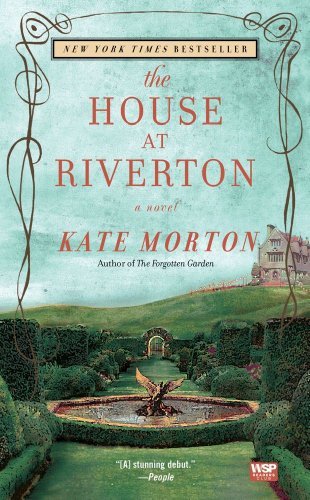
The House At Riverton by Kate Morton

"It is a cruel, ironical art, photography.  The dragged of captured moments into the future; moments that should have been allowed to be evaporated into the past; should exist only in memories, glimpsed through the fog of events that came after.  Photographs force us to see people before their future weighed them down.."